The short answer
The best wind blows from where deer will come from, toward you, so your scent drifts behind you and away from them. Winds are named for where they come from: if deer approach from the north, a north wind is ideal and a south wind blows your scent straight to them.
How a scent cone works
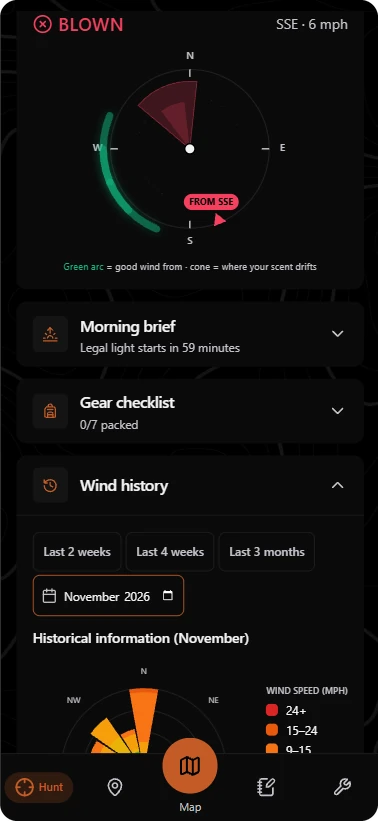
Your scent leaves you in a plume that drifts with the wind and widens the farther it goes. That plume is your scent cone. Any deer that steps into it can wind you, often well before it’s in range. Steady wind keeps the cone narrow and predictable. Light, shifting wind spreads it into a wide fan, and swirling wind in hills and creek bottoms can put it almost anywhere.
Deer know this too. Mature bucks often travel or bed with the wind at their back or quartering so they can smell what’s behind them and see what’s ahead. That’s why a stand that’s “on the trail” can still be wrong. You need the cone falling over ground they won’t use, including the route you walk in on.
Wind chart: which wind works for your stand
Find the direction deer will come from, then read across.
| Deer come from | Perfect wind | Workable crosswind | Blown, don’t sit |
|---|---|---|---|
| North | N, NNE, NNW | E or W, if the cone misses the trail | S, SSE, SSW |
| East | E, ENE, ESE | N or S | W, WNW, WSW |
| South | S, SSE, SSW | E or W | N, NNE, NNW |
| West | W, WNW, WSW | N or S | E, ENE, ESE |
| North & northwest | N, NNE, WNW, NW, NNW | NE or W | S, SE, SSE |
Terrain, cover, and thermals can bend these rules, which is why it helps to log what actually happens at each stand.
Thermals: the wind the forecast doesn’t show
On calm mornings, cool air sinks and slides downhill until the sun warms the ground. Then air starts rising uphill. In the evening it flips back and sinks as things cool. In hill country that can push your scent a different way than the forecast wind for the first hour of light. Rules of thumb: in the morning, hunt above where deer will be once the sun is up; in the evening, be careful of stands above bedding as air starts to fall.
Don’t forget your entry and exit
The wind at your stand isn’t the only one that matters. Walking in, your scent cone sweeps over everything downwind of your route. If that route crosses a bedding area or a field edge where deer are feeding, you’ve blown the sit before you climb. Pick routes that keep your cone over ground deer aren’t using at that hour.
How HuntSense handles stand wind
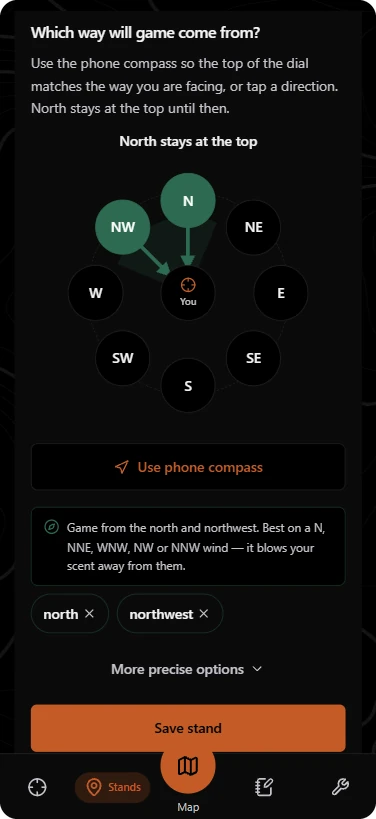
- Stand setup by game direction. Tap where deer come from on a compass dial, or use the phone compass. HuntSense names the winds that carry your scent away from them. You can skip it and set it after you scout.
- Perfect, marginal, or blown. Every forecast hour is rated for each stand, with a plain line like “Blown · Scent blows toward deer.”
- Scent cone on the compass and map. See the cone drift from your stand, and scrub it hour by hour on the map over your deer movement area.
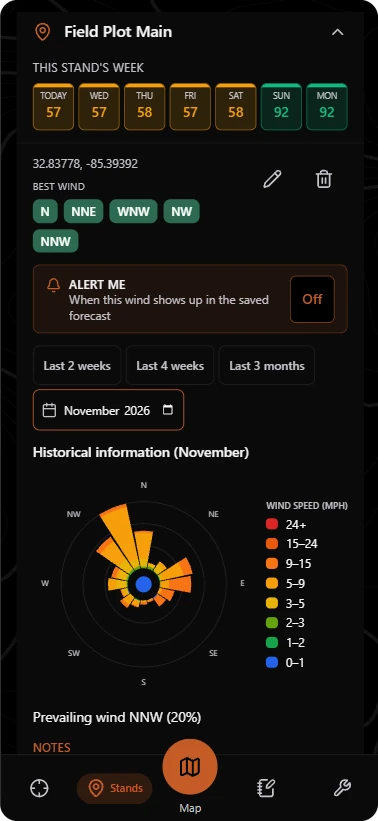
- Each stand’s week. A seven-day strip scored for that stand’s wind, so you can pick the right stand for the right day.
- Wind history. A wind rose for the last 2 weeks, 4 weeks, 3 months, or any month, with the prevailing wind, so you know what to expect before the season.
- Wind alerts. Turn on “Alert me” and HuntSense notifies you when that stand’s wind shows up in the saved forecast.

Know which stand to hunt this morning
Free for two stands. Pro ranks every stand on today’s wind.
Wind FAQ
Can you deer hunt with the wind at your back?
Only if no deer will be downwind of you. With the wind at your back, your scent cone covers everything in front of you, which is usually where you expect deer. Most hunters skip that stand and sit one that fits the wind.
How windy is too windy to deer hunt?
There’s no single number. Many hunters see less daylight movement in strong, gusty wind, while a steady moderate breeze makes your scent cone more predictable. A light, variable wind is often the hardest to hunt because it swirls.
Does a crosswind work?
Often, yes. A crosswind blows your scent sideways across the trail. It works when deer won’t be on the downwind side, and it doesn’t when they circle downwind before they commit, which bucks often do.
How does HuntSense rate stand wind?
You set the directions game comes from. HuntSense rates each forecast hour as perfect, marginal, or blown for that stand and shows the scent cone on the compass and map.