The short answer
To predict deer movement, connect where deer bed to where they feed, then hunt the travel route between them on a wind that blows your scent away from it. Fresh trails, rubs, and scrapes tell you which route is in use right now.
How deer move in a normal day
Whitetails and mule deer are most active around dawn and dusk. In the evening they leave bedding cover and work toward food: crop fields, food plots, oak flats dropping acorns, or browse in a cutover. Overnight they feed and move. By first light they drift back toward cover to bed for the day.
That gives two hunts with different setups. Evening sits work near the food edge or on a staging area just inside cover. Morning sits work between food and bed, close enough to cover that you catch deer heading in, without bumping them off the field in the dark.
Reading the sign
| Sign | What it tells you | Where to set up |
|---|---|---|
| Beds | Oval flattened spots in thick cover, south-facing slopes in cold weather, or points with a view and a wind at their back. | Not on top of them. Set up on the trail leaving or entering the bedding area. |
| Feed | Tracks, droppings, and browse at fields, plots, mast trees, or cutovers. Changes through the season. | Evening: field edge or staging cover. Morning: the route back to bed. |
| Travel | Funnels, pinch points, saddles, creek crossings, and fence gaps that squeeze movement. | The best all-day stands, especially during the rut. |
| Trails, rubs & scrapes | Which routes are used now. Rub lines often follow a buck’s travel between bed and feed. | Downwind of where trails meet or a rub line crosses a funnel. |
How movement changes through the season
- Early season: deer are patterned on food and water. Evening sits near feed are the most predictable of the year.
- Pre-rut: rubs and scrapes show up along travel routes. Bucks start checking doe bedding areas.
- Rut: bucks cruise for does at any hour. Funnels between doe bedding areas can produce all day.
- Post-rut and late season: deer go back to food, especially high-energy food in cold weather. The first hard cold front can put deer on feed in daylight.
Weather, pressure, and the moon
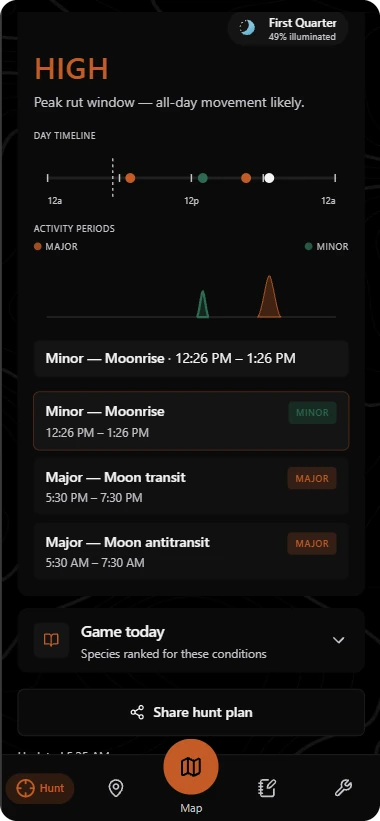
Many hunters see more daylight movement ahead of a cold front, as pressure falls, and on the first cold days after a warm spell. Strong wind and heat usually cut daylight movement. Solunar theory says major and minor moon periods line up with more activity. Use these to pick the day; use sign and wind to pick the stand. You can check today’s windows with the free solunar tool.
How HuntSense predicts deer movement
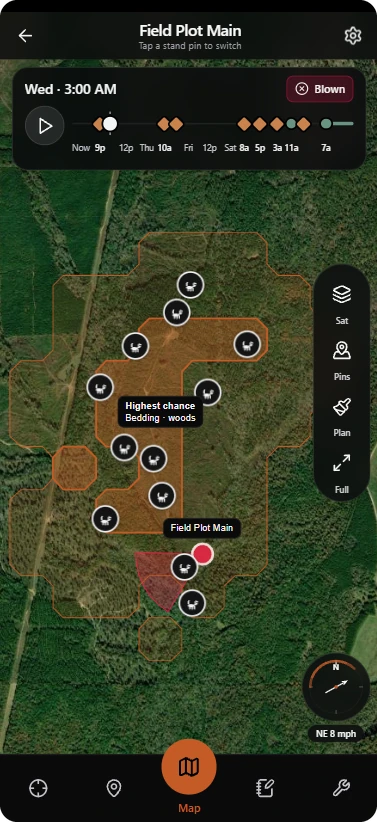
HuntSense does the bed-to-feed math on a map, from your scouting. It doesn’t use other hunters’ reports or a generic deer model. It uses the pins you drop on your own ground.
- Open the stand map and switch to pins. Mark bed, feed, travel, and trail sign where you find it, or drop a pin at your GPS location.
- See the likely area. The map shades the ground deer are most likely to use, blending your pins with habitat and terrain when they’re available.
- Read the highest chance. A label names the best bet, like “Bedding · woods”, so you know which corner to hunt.
- Watch it tighten. The area starts wide. Every pin that agrees pulls it in and raises confidence.
- Check the wind. Scrub the forecast to see where your scent cone falls over that ground hour by hour, and whether the wind is perfect, marginal, or blown.
Free covers one sighting session with one pin each for bed, feed, travel, and trail, drawn as a wide area. HuntSense Pro adds more sessions and pins and the tighter area as pins agree.

Map your deer before the next sit
Free on Google Play. No account, and your pins stay on your phone.
Deer movement FAQ
What time of day do deer move most?
Around dawn and dusk. In the morning they head from feed back to bedding cover; in the evening they leave bedding for food. During the rut bucks can move at any hour, including midday.
How far do deer travel from bed to feed?
It depends on the land. Where cover and food sit close together, it can be a few hundred yards. In open or big-woods country it can be much farther. Your trail and track sign is a better guide than any rule of thumb.
Does weather affect deer movement?
Yes. Falling pressure before a front, the first cold snap, and calm mornings tend to help. Heavy wind and heat tend to hurt. HuntSense weighs wind, pressure, and solunar windows in its 0–100 hunt score.
Can HuntSense predict deer movement on my land?
Yes, from your own scouting. It shades the likely area and names the highest-chance spot, then tightens as your pins agree. It’s planning guidance, not a guarantee of a deer.