The short answer
Use doe bleats and contact grunts any time of season, tending grunts and estrus bleats in the pre-rut and rut, and fawn calls early in the season or to pull in does. Call sparingly, and always set up so a deer circling downwind of the sound won’t walk into your scent cone.
Deer call chart
| Call | What it says | Best time |
|---|---|---|
| Buck grunt | A short “I’m here” contact call between deer. | All season; most response pre-rut and rut. |
| Social grunt | Relaxed, low-intensity grunting from a deer moving or feeding. | All season; good for calming a nervous deer. |
| Tending grunt | Quick, rhythmic grunts from a buck trailing a doe near estrus. | Rut. Suggests a hot doe is close. |
| Dominant grunt | A deep, drawn-out challenge from a mature buck. | Peak rut, sparingly. It can scare off younger bucks. |
| Doe bleat | A social, non-threatening doe call. | All season. Draws curious does and the bucks following them. |
| Estrus bleat | A longer, drawn-out bleat from a doe ready to breed. | Pre-rut and rut. |
| Doe in heat | A variation on the estrus bleat. | Rut. |
| Fawn distress | A loud, urgent bawl from a fawn in trouble. | Early season to bring in does. Also draws predators. |
| Lost fawn | A softer fawn bleat looking for its mother. | Early season. |
How to call deer without spooking them
- Call less. When blind calling, a short sequence every 20 to 30 minutes is plenty. Overcalling sounds wrong.
- Start soft. A deer may be closer than you think. Get louder only if the wind or terrain swallows the sound.
- Stop when one responds. Once a deer is coming, let it look for the sound. Get your weapon ready.
- Play the wind. Bucks often circle downwind of a call to scent-check it. Set up so that side is open ground or blocked by terrain. Check your stand’s wind rating first.
- Match the season. Aggressive calls in the early season can push deer out. Save the dominant grunt for when bucks are actually fighting for does.
Is it legal to call deer with a phone?
It depends where you hunt. Many states prohibit electronic calls for deer, turkey, and other big game, while allowing them for predators like coyotes and foxes. Use HuntSense to learn and practice the sounds, then use a mouth or hand call in the field where electronic calls aren’t allowed. Always check your state’s current regulations.
Game calls in HuntSense
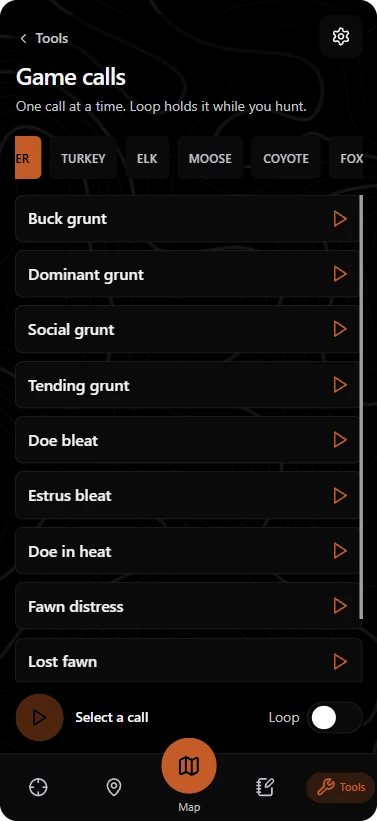
HuntSense carries a library of game calls that play and loop with no signal. Tabs cover deer, turkey, elk, moose, coyote, fox, and more. The deer tab includes buck grunt, dominant grunt, social grunt, tending grunt, doe bleat, estrus bleat, doe in heat, fawn distress, and lost fawn. The free version includes a call for each animal group; Pro opens the full library.
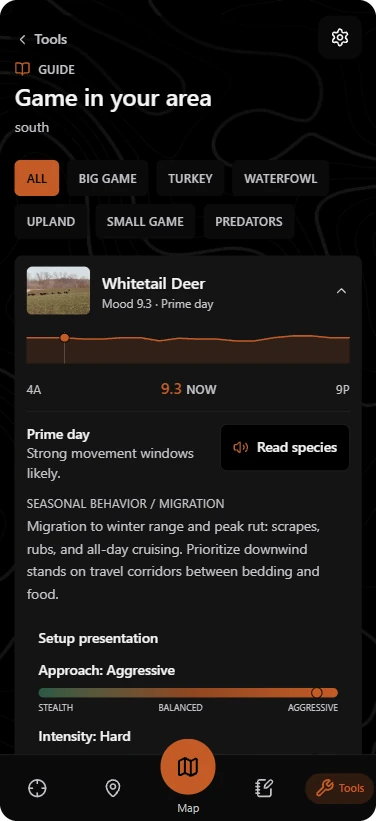
The same Tools tab has the game guide. Pick your area and it ranks the species that fit today: whitetail, turkey, waterfowl, upland, small game, and predators. Each card has a mood score, seasonal behavior, and setup advice, like whether to hunt stealthy or aggressive today.

Calls, species intel, and stand wind
Free on Google Play. Calls and the guide work offline.
Deer calling FAQ
When should you use a doe bleat?
Any time of season. It’s a social, non-threatening sound that draws curious does and the bucks looking for them.
What’s the difference between a buck grunt and a tending grunt?
A buck grunt is a short contact call. A tending grunt is a run of quick grunts from a buck following a doe in or near estrus, so it’s most useful in the rut.
Do deer calls work in the early season?
Soft doe bleats, contact grunts, and fawn calls can. Aggressive calls usually work better once the pre-rut starts.
Is it legal to use a phone app to call deer?
In many states, no. Electronic calls for big game are often banned while predator calls are allowed. Check your regulations.